
PART 5
The following may, however, be mentioned:
The blandishments of love are a manner of battle, in which the stronger wins the day. And in order to assist us in the struggle, there are two forms of attack, known as Karatadana and Sitkreutoddesha.
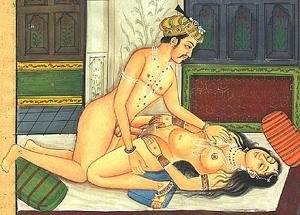
Karatadana, as the word denotes, “are soft tappings and pattings with the hand, by the husband or the wife, upon certain members of each other’s persons. And in this process there are four divisions, which the man applies to the woman:
1. Prasritahasta, or patting with the open palm.
2. Uttanyahasta, the same reversed; done with the back of the hand.
3. Mushti, or striking gently with the lower or fleshy part of the closed hand; softly hammering, as it were.
4. Sampatahasta, or patting with the inner part of the hand, which is slightly hollowed for the purpose, like the cobra’s hood.
And here may be specified the several members that should thus be operated upon.
1. the flesh below the ribs, with No.1
2. the Mons Veneris and vicinity of the Yoni; also with No.1
3. the bosom and breasts, with No.2
4. the back and hip, with No.3
5. the head with No.4
There are also four corresponding divisions of the practices used by the woman to the man:
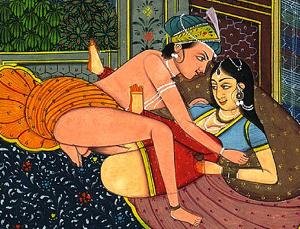
1. Santanika, a name given by learned men to the act of a wife gently patting with the closed fist her husband’s breast when the two have become one, so as to increase his pleasure.
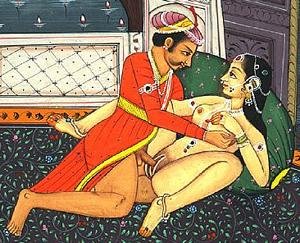
2. Pataka is when the wife, also during congress, pats her husband gently with the open hand.
3. Bindumala is the name given only by men when the wife, at the time of coition, fillips her husband’s body with the thumbs only.
4. Kundala is the name given by the older poets when the wife, during copulation, fillips her husband’s body with thumb and fore-finger, not with the rest of the hand.
And now of the Sitkriti, or inarticulate sound produced by drawing in the breath between the closed teeth; these are the peculiar privilege and prerogative of women, and the wise divide them into five kinds:
1. Hinkriti is the deep and grave sound, like “Hun! Hun! Hun!”, or “Hin! Hin! Hin!” produced in the nose and mouth with the slightest use of the former member.
2. Stanita is the low rumbling, like distant thunder, expressed by “Ha! Ha!” or by “Han! Han! Han!” produced by the throat without the concurrence of the nasal muscles.
3. Sitkriti is the expiration or emission of breath, like the hissing of a serpent, expressed by “Shan! Shan!” or “Shish! Shish!” and produced only in the mouth.
4. Utkriti is the cracking sound, resembling the splitting of a bamboo, expressed by “T’hat! t’hat!” and formed by applying the tongue-tip to the palate, and by moving it as rapidly as possible, at the same time pronouncing the interjection.
5. Bhavakriti is a rattling sound, like the fall of heavy rain-drops, expressed by “T’hap! t’hap!” produced by the lips: but it can be produced only at the time of congress.
These several Sitkritis in the woman’s mouth at the moment of enjoyment, will respectively resemble the cry of the quail (Lava), of the Indian cuckoo (Kokila), of the spotted-necked pigeon (Kapota), of the Hansa-goose and of the peacock.
PART 1 | PART 2 | PART 3
PART 4 | PART 5 | PART 6