

PART 1
By “external enjoyments” are meant the processes which should always precede internal enjoyment or coition.
The wise have said that before congress, we must develop the desire of the weaker sex through certain preliminaries, which are many and various; such as the various embraces and kisses; the Nakhadana, or unguiculations; the Dashanas, or morsications; the Keshagrahanas, or manipulating the hair, and other amorous blandishments.
These affect the senses and divert the mind from coyness and coldness. After which tricks and toyings, the lover will proceed to take possession of the place.
There are eight Alinganas, or modes of embracing which will here be enumerated and carefully described:
1. Vrikshadhirudha is the embrace which simulates the climbing of a tree, and it is done as follows: When the husband stands up the wife should place one foot upon his foot, and raise the other leg to the height of his thigh, against which she presses it.
Then encircling his waist with her arms, even as a man prepares to swarm up a palm-trunks, she holds and presses him forcibly, bends her body over his, and kisses him as if sucking the water of life.
2. Tila-Tandula, the embrace which represents the mixture of sesamum-seed with husked rice (Tandul).
The man and woman, standing in front of each other, should fold each other to the bosom by closely encircling the waist.
Then taking care to remain still, and by no means to move, they should approach the Linga to the Yoni, both being veiled by the dress, and avoid interrupting the contact for some time.
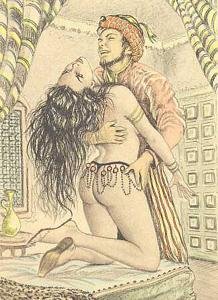
3. Lalatika, so called because forehead (lalata) touches forehead. In this position great endearment is shown by the close pressure of arms round the waist, both still standing upright, and by the contact of brow, cheek, and eyes, of mouth, breasts, and stomach.
4. Jaghan-alingana, meaning “hips, loins, and thighs.” In this embrace the husband sits (sitting invariably means cross-legged, like a tailor upon his board, or at squat, like a bird, and the seat is a mat, or carpet, in India, and a divan in the nearer East) upon the carpet and the wife upon his thighs, embracing and kissing him with fond affection.
In returning her fondling, her Lungaden, or petticoats, are raised, so that her Lungi, or under-garments, may come in contact with his clothes, and her hair is thrown into the dishevelled state, symbolizing passion; or the husband, for variety’s sake, may sit upon the wife’s lap.
5. Viddhaka, when the nipples touch the opposite body. The husband sits still, closing his eyes, and the wife, placing herself close to him, should pass her right arm over his shoulder and apply her bosom to his, pressing him forcibly, whilst he returns her embrace with equal warmth.
6. Urupagudha, so called from the use of the thighs. In this embrace both stand up, passing their arms round each other, and the husband places his wife’s legs between his own so that the inside of his thighs may come in contact with the outside of hers.
As in all cases, kissing must be kept up from time to time. This is a process peculiar to those who are greatly enamoured of each other.
7. Dughdanir-alingana, or the “milk and water embrace,” also called “Kshiranira,” with the same signification. In this mode the husband lies upon the bed, resting on one side, right or left; the wife throws herself down near him with her face to his, and closely embraces him, the members and limbs of both touching, and entangled, as it were, with the corresponding parts of the other. And thus they should remain until desire is thoroughly aroused in both.

8. Valleri-vreshtita, or “embracing as the creeper twines about the tree”, is performed as follows: Whilst both are standing upright, the wife clings to her husband’s waist, and passes her leg around his thigh, kissing him repeatedly and softly until he draws in his breath like one suffering from the cold. In fact, she must endeavour to imitate the vine enfolding the tree which supports it.
Here end the embracements; they should be closely studied, followed up by proper intelligence of the various modes of kisses, which must accompany and conclude the Alinganas.
PART 1 | PART 2 | PART 3
PART 4 | PART 5 | PART 6