

PART 4
Like the unguiculations, there are seven different Dashanas or ways of applying the teeth, which may be remembered by the following Mandalaka or oblong formula:
1. Gudhaka-dashana, or “secret biting”, is applying the teeth only to the inner or red part (the darker Hindus, like Africans, do not show redness in the lips, and the Arabs, curious to say, exceedingly admire brown lips) of the woman’s lip, leaving no outside mark so as to be seen by the world.
2. Uchun-dashana, the wise tell us, is the word applied to biting any part of a woman’s lips or cheeks.
3. Pravalamani-dashana, or “coral biting”, is that wonderful union of the man’s tooth and the woman’s lips, which converts desire into a burning flame; it cannot be described, and is to be accomplished only by long experience, not by the short practice of a few days.
4. Bindu-dashana (“dot” or “drop-biting”) is the mark left by the husband’s two front teeth upon the woman’s lower lip, or upon the place where the Tilla or brow-mark is worn.
5. Bindu-mala (a “rosary”, or “row of dots” or “drops”), is the same as the preceding, except that A the front teeth are applied, so as to form a regular line of marks.
6. Khandabhrak is the duster or multitude of impressions made by the prints of the husband’s teeth upon the brow and cheek, the neck and breast of the wife. If disposed over the body like the Mandalaka, or Dashanagramandal, the mouth-shaped oblong traced above, it will greatly add to her beauty.
7. Kolacharcha is the name given by the wise to the deep and lasting marks of his teeth which the husband, in the heat of passion, and in the grief of departure when going to a foreign land, leaves upon the body of his wife. After his disappearance, she will look at them, and will frequently remember him with yearning heart.

So far for the styles of morsication. And now it is advisable to study the different fashions of Keshagrahana, or manipulating the hair, which, upon a woman’s head, should be soft, close, thick, black, and wavy, not curled, nor straight.
One of the best ways of kindling hot desire in a woman is, at the time of rising, softly to hold and handle the hair, according to the manner of doing so laid down in the Kamashastra.
The Keshagrahana are of four kinds:
1. Samahastakakeshagrahana, or “holding the hair with both hands”, is when the husband encloses it between his two palms behind his wife’s head, at the same time kissing her lower lip.
2. Tarangarangakeshagrahana, or “kissing the hair in wavy (or sinuous) fashion”.. is when the husband draws his wife towards him by the back hair, and kisses her at the same time.
3. Bhujangavallika, or the “dragon’s turn” (Bhujanga is a dragon, a cobra, a snake generically, or a man who keeps a mistress), is when the husband, excited by the approaching prospect of sexual congress, amorously seizes the hind knot of his wife’s hair, at the same time closely embracing her. This is done in a standing position, and the legs should be crossed with one another. It is one of the most exciting of all toyings.
4. Kamavatansakeshagrahana, or “holding the crest hair of love”,” is when, during the act of copulation, the husband holds with both hands his wife’s hair above her ears, whilst she does the same thing to him, and both exchange frequent kisses upon the mouth.
Such, then, are the external enjoyments described in the due order according to which they ought to be practised. Those only are mentioned which are well known to, and are highly appreciated by the world.
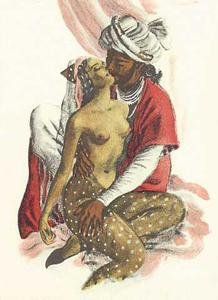
There are many others by no means so popular, and these are omitted, lest this treatise become an unwieldy size (The reader will remember that the Hindus, as a rule, are a race of vegetarians, who rarely drink any stimulant such as wine, ale and spirits, or even tea, coffee and chocolate. They look with horror upon the meat-eater, that makes his body a grave for the corpses of animals; and they attach a bad name to all narcotics except tobacco, leaving opium and Bhang or Hashish to low fellows and ribald debauchees. It is evident that, under such circumstances, their desires, after the first heat of youth, will be comparatively cold, and that both sexes, especially the weaker, require to be excited by a multitude and a variety of preliminaries to possession, which would defeat their own object in case of Europeans. Thus also we may account for their faith in pepper, ginger, cloves, cinnamon, and other spices which go by the name of “Garm Masala,” or hot condiments; these would have scanty effect upon the beef-eating and beer-bibbing Briton, but they exert a suifficiently powerful action upon a people of water-drinkers and rice or pulse-feeders).
PART 1 | PART 2 | PART 3
PART 4 | PART 5 | PART 6