
Now some may ask here: If men and women are beings of the same kind, and are engaged in bringing about the same results, why should they have different works to do?
Vatsya says that this is so, because the ways of working as well as the consciousness of pleasure in men and women are different.
The difference in the ways of working, by which men are the actors, and women are the persons acted upon, is owing to the nature of the male and the female, otherwise the actor would be sometimes the person acted upon, and vice versa.
And from this difference in the ways of working follows the difference in the consciousness of pleasure, for a man thinks, “this woman is united with me”, and a woman thinks, “I am united with this man”.
It may be said that, if the ways of working in men and women are different, why should not there be a difference, even in the pleasure they feel, and which is the result of those ways.
But this objection is groundless, for, the person acting and the person acted upon being of different kinds, there is a reason for the difference in their ways of working; but there is no reason for any difference in the pleasure they feel, because they both naturally derive pleasure from the act they perform.
(This is a long dissertation very common among Sanscrit authors, both when writing and talking socially. They start certain propositions, and then argue for and against them.
What it is presumed the author means is that, though both men and women derive pleasure from the act of coition, the way it is produced is brought about by different means, each individual performing his own work in the matter, irrespective of the other, and each deriving individually their own consciousness of pleasure from the act they perform.)
There is a difference in the work that each does, and a difference in the consciousness of pleasure that each has, but no difference in the pleasure they feel, for each feels that pleasure to a greater or lesser degree.
On this again some may say that when different persons are engaged in doing the same work, we find that they accomplish the same end or purpose; while, on the contrary, in the case of men and women we find that each of them accomplishes his or her own end separately, and this is inconsistent.
But this is a mistake, for we find that sometimes two things are done at the same time, as for instance in the fighting of rams, both the rams receive the shock at the same time on their heads.

Again, in throwing one wood apple against another, and also in a fight or struggle of wrestlers. If it were said that in these cases the things employed are of the same kind, it would be answered that even in the case of men and women, the nature of the two persons is the same.
And as the difference in their ways of working arises from the difference of their conformation only, it follows that men experience the same kind of pleasure as women do.
There is also a verse on this subject as follows:
“Men and women, being of the same nature, feel the same kind of pleasure, and therefore a man should marry such a woman as will love him ever afterwards.”
The pleasure of men and women being thus proved to be of the same kind, it follows that, in regard to time, there are nine kinds of sexual intercourse, in the same way as there are nine kinds, according to the force of passion.
There being thus nine kinds of union with regard to dimensions, force of passion, and time, respectively, by making combinations of them, innumerable kinds of union would be produced.
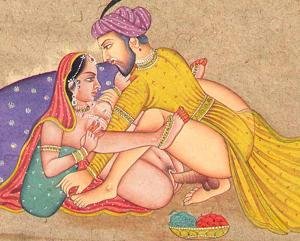
Therefore in each particular kind of sexual union, men should use such means as they may think suitable for the occasion. (This paragraph should be particularly noted, for it specially applies to married men and their wives. So many men utterly ignore the feelings of the women, and never pay the slightest attention to the passion of the latter. To understand the subject thoroughly, it is absolutely necessary to study it, and then a person will know that, as dough is prepared for baking, so must a woman be prepared for sexual intercourse, if she is to derive satisfaction from it.)
At the first time of sexual union the passion of the male is intense, and his time is short, but in subsequent unions on the same day the reverse of this is the case.
With the female, however, it is the contrary, for at the first time her passion is weak, and then her time long, but on subsequent occasions on the same day, her passion is intense and her time short, until her passion is satisfied.
ON THE DIFFERENT KIND OF LOVE
Men learned in the humanities are of opinion that love is of four kinds:
Love acquired by continual habit
Love resulting from the imagination
Love resulting from belief
Love resulting from the perception of external objects
Love resulting from the constant and continual performance of some act is called love acquired by constant practice and habit, as for instance the love of sexual intercourse, the love of hunting, the love of drinking, the love of gambling, etc.
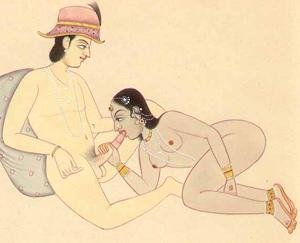
Love which is felt for things to which we are not habituated, and which proceeds entirely from ideas, is called love resulting from imagination, as for instance that love which some men and women feel for the Auparishtaka or mouth congress, and that which is felt by all for such things as embracing, kissing, etc.
The love which is mutual on both sides, and proved to be true, when each looks upon the other as his or her very own, such is called love resulting from belief by the learned.
The love resulting from the perception of external objects is quite evident and well known to the world because the pleasure which it affords is superior to the pleasure of the other kinds of love, which exists only for its sake.
What has been said in this chapter upon the subject of sexual union is sufficient for the learned; but for the edification of the ignorant, the same will now be treated of at length and in detail.