
PART 1
The following table will show the peculiarities of women according to the four periods of life during which she is open to love.
It may be premised that she is called Kanya from birth to the age of eight years, which is the time of Balyavastha, or childhood; and Gauri, after the white goddess Parvati, from that period to her eleventh year; Tarunyavastha when she becomes marriageable: then follow Yavavastha, young-womanhood, and Vreuddhavastha, old-womanhood.
Showing qualities attached to the several ages
|
Age |
Name |
Regarded art of love |
Kind of congress preferred |
How subjected |
|
11-16 years |
Bala |
Fit |
In darkness |
By flowers, small presents, gifts of betel, and so on |
|
16-30 years |
Taruni |
Do. |
In light |
By gifts of dresses, pearls and ornaments |
|
30-55 years |
Praudha |
Fit |
Both in darkness and in light |
By attention, politeness, kindness and love |
|
Beyond 55 years |
Viddha |
Unfit |
Becomes sick and infirm |
By flattery |
And further observe that there are three temperaments of women, as shown by the following characteristics:
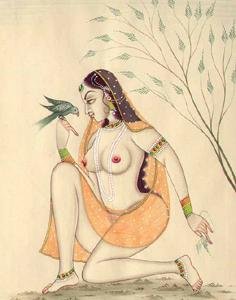
The signs of Kapha (lymphatic or phlegmatic diathesis) are bright eyes, teeth and nails; the body is well preserved, and the limbs do not lose their youthful form.
The Yoni is cool and hard, fleshy, yet delicate; and there is love and regard for the husband. Such is the lymphatic, or the highest temperament (in old European physiology it ranked lowest).
The next is the Pitta, or bilious diathesis. The woman whose bosom and nates are flaccid and pendant, not orbiculate; whose skin is white, whilst her eyes and nails are red; whose perspiration is sour, and whose Yoni is hot and relaxed; who is well versed in the arts of congress, but who cannot endure it for a long time, and whose temper is alternately and suddenly angry and joyous, such a one is held to be of the Pitta or bilious temperament.
She whose body is dark, hard, and coarse; whose eyes and finger nails are blackish, and whose Yoni, instead of being smooth, is rough as the tongue of a cow; she whose laugh is harsh; whose mind is set on gluttony; who is volatile and loquacious, whilst in congress she can hardly be satisfied, that woman is of the Vata or windy temperament, the worst of all.
Furthermore, women require to be considered in connection with the previous state of their existence; the Satva, or disposition inherited from a former life, and which influences their worldly natures.
The Devasatva-stri, who belongs to the Gods, is cheerful and lively, pure-bodied and clean, with perspiration perfumed like the lotus-flower; she is clever, wealthy and industrious, of sweet speech and benevolent, always delighting in good works; her mind is sound as her body, nor is she ever tired or displeased by her friends.
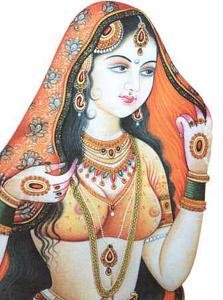
The Gandharvasarva-stri, who derives a name from the Gandharvas, or heavenly minstrels, is beautiful of shape, patient in mind, delighting in purity; wholly given to perfumes, fragrant substances and flowers, to singing and playing, to rich dress and fair ornaments, to sport and amorous play, especially to the Vilasa, one of the classes of feminine actions which indicate the passion of love.
The Yakshasatva-stri, who derives a name from the demi-god presiding over the gardens and treasures of Kuvera (Hindu Plutus, god of wealth) has large and fleshy breasts, with a skin fair as the white champa-flower (michelia champac); she is fond of flesh and liquor; devoid of shame and decency; passionate and irascible, and at all hours greedy for congress.
PART 1 | PART 2 | PART 3 | PART 4