

PART 4
And furthermore, learn that there are four kinds of the Priti, or love-tie connecting men and women:
1. Naisargiki-priti is that natural affection by which husband and wife cleave to each other like the links of an iron chain. It is a friendship amongst the good of both sexes.
2. Vishaya-priti is the fondness born in the woman, and increased by means of gifts, such as sweetmeats and delicacies, flowers, perfumery, and preparations of sandalwood, musk, saffron, and so forth. It partakes, therefore, of gluttony, sensuality and luxury.
3. Sama-priti is also so far sensual, as it arises from the equally urgent desires of both husband and wife.
4. Abhyasiki-priti is the habitual love bred by mutual society: it is shown by walking in fields, gardens and similar places; by attending together at worship, penances and self-imposed religious observances; and by frequenting sportive assemblies, plays and dances, where music and similar arts are practised.
And, moreover, let it be noted, that the desires of the woman being colder, (this is the Hindu view: The Moslems hold that the desires of a woman are ten times stronger than those of a man. Both are right in certain exceptions; for instance the male is the stronger in dry climates, the female in the hot, damp and depressing) and slower to rouse than those of the man, she is not easily satisfied by a single act of congress; her slower powers of excitement demand prolonged embraces, and if these be denied her, she feels aggrieved.

At the second act, however, her passions being thoroughly aroused, she finds the orgasm more violent, and then she is thoroughly contented.
This state of things is clean reversed in the case of the man, who approaches the first act burning with love heat, which cools during the second, and which leaves him languid and disinclined for a third.
But the wise do not argue therefrom, that the desires of the woman, as long as she is young and strong, are not at the full as real and urgent as those of the man.
The custom of society and the shame of the sex may compel her to conceal them and even to boast that they do not exist; yet the man who has studied the Art of Love is never deceived by this cunning.
And here it is necessary to offer some description of the Yoni; it being of four kinds.
1. That which is soft inside as the filaments of the lotus-flower; this is the best.
2. That whose surface is studded with tender flesh-knots and similar rises.
3. That which abounds in rolls, wrinkles, and corrugations.
4. That which is rough as the cow’s tongue; this is the worst.
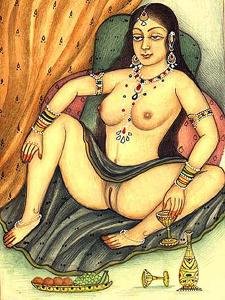
Moreover, in the Yoni there is an artery called Saspanda; which corresponds with that of the Linga, and which, when excited by the presence and energetic action of the latter, causes Kama-salila to flow.
It is inside and towards the navel, and it is attached to certain roughnesses (thorns), which are peculiarly liable to induce the paroxysm when subjected to friction.
The Madana-chatra (the clitoris), in the upper part of the Yoni, is that portion which projects like the plantain-shoot sprouting from the ground; it is connected with the Mada-vahi (sperm-flowing) artery, and causes the latter to overflow.
Finally, there is an artery, termed Purna-chandra, which is full of the Kama-salila, and to this the learned men of old attribute the monthly ailment.
PART 1 | PART 2 | PART 3 | PART 4